Ask precisely.
Let reality answer.
A good robot begins with questions we can test. What touches the object? What changes? And what would prove us wrong?
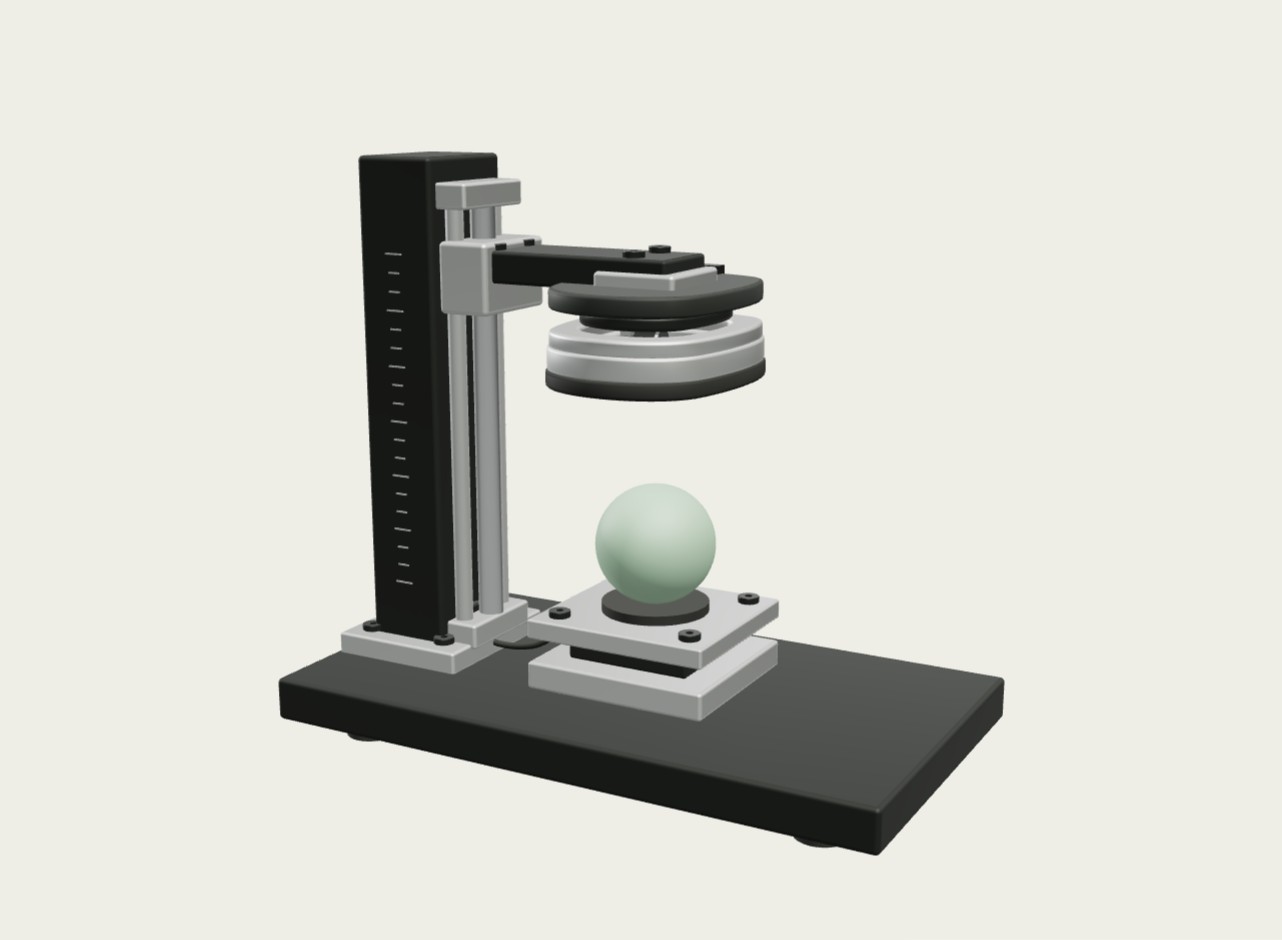
The contact experiment · Three-dimensional study
Make the conditions explicit.
A reference object rests on the instrumented platform. The cartridge begins clear of its surface. Object geometry, approach speed and sensing calibration would be recorded before a test.
Proposed test-fixture illustration. No solved contact mechanics, selected force sensor or measured performance. Exploded view opens only the tactile cartridge.
Inside The contact experiment
- Guided carriage
- A rigid frame and paired guide rods define the intended approach axis.
- Tactile cartridge
- The same sensing-island concept shown on Company becomes the subject of a repeatable experiment.
- Reference object
- A known object would separate repeatability tests from later trials with changing materials and surfaces.
- Instrumented platform
- A retained platform and attached signal cable indicate where reaction force would be measured. Sensor selection and calibration remain open.
One question.
Conditions we can repeat.
Begin with the smallest experiment that can distinguish a useful mechanism from an attractive idea. Hold the object, mounting and approach constant. Change one deliberate input.
For touch, the question may be whether a sensing island can detect a surface change without disturbing the surrounding grip. A repeatable fixture gives that question a physical setting.
Predict it.
Test it.
Question it again.
Geometry and calculations describe what we expect. Measurements describe what happened. A discrepancy is a reason to revise the model, the mechanism or the experiment.
A separate reviewer checks the exact design revision, the test conditions and the limits of the conclusion. A convincing render is only the beginning of that work.
Explore the engineeringA claim should survive a test.
Follow a design question from an explicit assumption to an independently examined result.
Define the task, conditions, limits and what would constitute success.
Explanatory diagram · Select a connection to inspect its role.