Handle the delicate.
A herb leaf, a ripe berry, the edge of a thin pastry. The goal is to make contact without leaving a mark.
We’re developing robotic bodies and the intelligence that moves them. Precision hardware. Sensitive touch. Learning grounded in the physical world.
A humanoid ambition.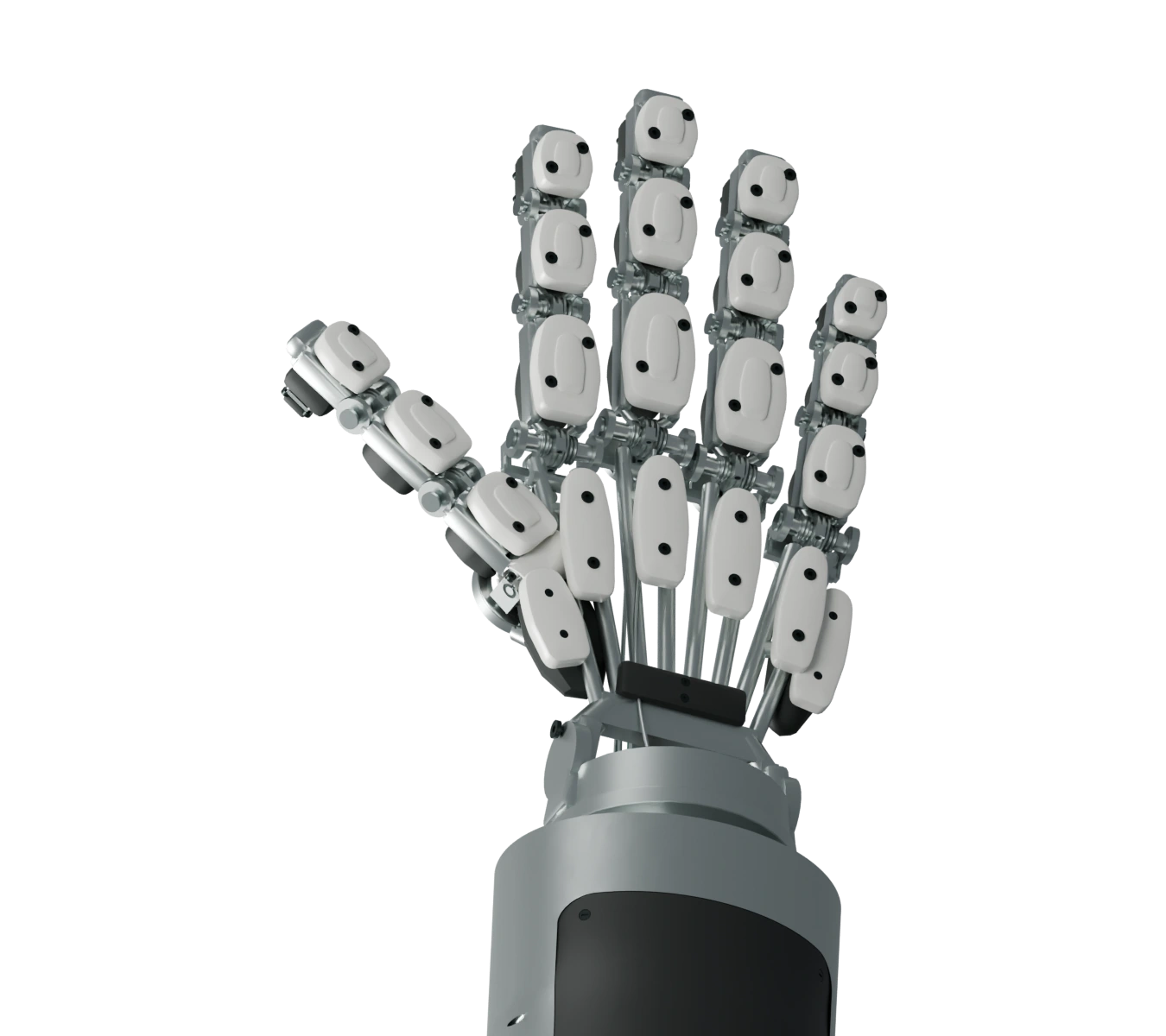
Hand to arm · Three-dimensional study
Explore the articulated hand, then select Complete arm to follow its connection through the forearm, elbow and shoulder to the desk clamp.
Development study. Motion illustrates joint geometry; working tendon control and physical validation remain unfinished. Exploded view omits the two modeled wrist tendon strands; rigid guides and the passive electrical harness remain visible. Reassemble to inspect the actual modeled routes.
Our ambition is a humanoid that learns from humanity’s knowledge and its own contact with the world. We develop the machine and its intelligence together.
Explore custom actuation, tendon transmission and the sensing that connects a movement to its consequences.
Inside the engineeringPhysical intelligenceExplore our world-model research direction: learning from knowledge, predicting outcomes and refining them through experience.
Inside the intelligenceAn arm on a desk gives us a focused place to develop manipulation. It can reach, orient a hand and make contact while its base stays fixed. We can study those problems before adding the balance and locomotion of a complete body.
The hand sets the challenge: human-like dexterity, sensitivity and the ability to respond to an unfamiliar object. The rest of the arm must put that hand in the right place, support it and bring its signals back.
Explore the development study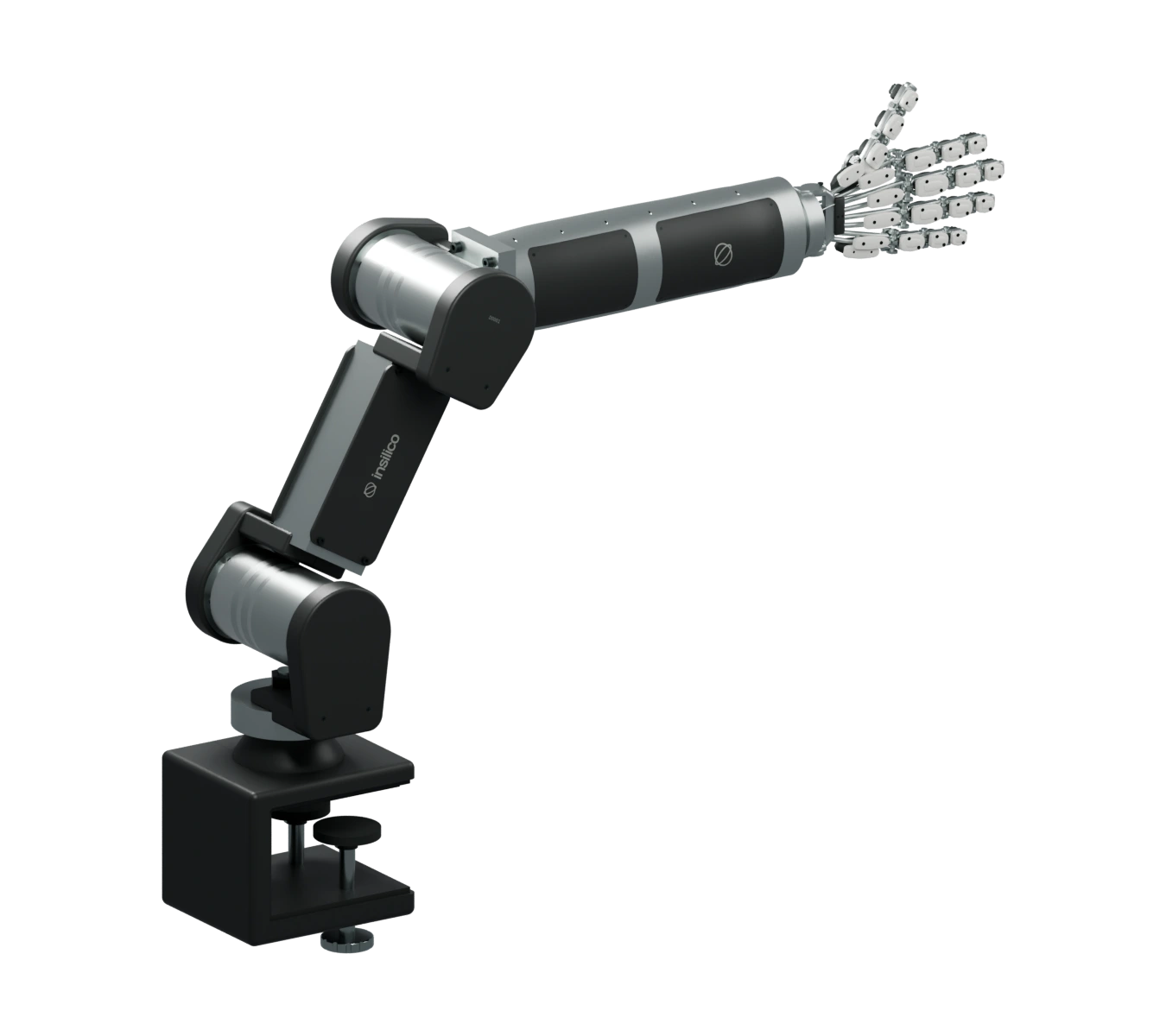
Source-derived CAD / Development study
An opposing thumb and articulated fingers give us a starting point for varied grasps. Our aim is to feel contact, detect slipping and adjust force before an object is damaged.
Replaceable contact surfaces, joint sensing and tactile research belong together. Human-like sensitivity is the development target; it has not yet been demonstrated by this hand.
The wrist transfers structural loads while tendons carry finger forces and a separate electrical harness carries power and sensor data.
This revision uses a retained, fixed wrist. The selected pose still leaves gaps at both middle-finger tendon terminals; complete routing remains unverified. Four power/data conductors and a shield drain now connect passive wrist boards in CAD. Active electronics, complete arm wiring and moving-wrist compensation remain in development.
Twenty-one custom finger-drive cartridges sit within a compact, tapered forearm. Placing the drives here keeps their bulk away from the fingertips.
Removable panels provide access to the drive bank. The proposed vision system also mounts to the forearm chassis, with a known relationship to the hand.
The elbow changes reach without asking the fingers to compensate for the entire arm. A custom transmission study explores that movement inside a rounded joint enclosure.
Joint strength, braking and protected powered operation still need qualification. The website motion shows prescribed geometry.
The upper arm connects the shoulder to the elbow and provides space for the proposed power and data route. Wiring needs protected transitions and service allowance at each moving joint.
Finger tendons run between forearm and hand. Electrical connections must continue through the whole arm; a hollow link alone does not complete that connection.
A compact clamp anchors the development arm to a suitable surface edge. Accessible adjustment and a sculpted exterior make the foundation part of the same design.
The clamp is designed around a nominal 20–50 mm edge. Each supporting surface, load and mounting condition still needs verification.
Vision helps identify objects and plan an approach. Touch helps decide what happens after contact. We are developing an intelligence layer that can connect both to the arm’s state.
The camera would mount rigidly to the forearm and move with it. Calibration and capture timing must account for that motion. Our internal simulator is being developed to test perception, movement and control before physical trials.
Intelligence for the physical worldGrasping asks for a stable contact. Understanding a material often asks for movement. We want to explore a fingertip that can do both: a supporting perimeter around an independently moving sensing island.
The hard question is whether useful tactile information can survive changing grip force, moisture and wear. That question shapes the hand from the fingertip inward.
Inside the contact cartridgeA herb leaf, a ripe berry, the edge of a thin pastry. The goal is to make contact without leaving a mark.
Wet surfaces and changing resistance make a kitchen a demanding test of touch. The hand must learn when to yield, hold or adjust.
Replaceable contact skins and accessible sensing cartridges make cleaning and service part of the architecture from the start.
Culinary dexterity is the development goal. Cooking also requires coordinated arms, perception and planning.
Explore the geometry, the proposed connections and the questions still open. Each study is a step toward a body that can act with precision and learn from what happens next.
The arm connects a decision to a physical interaction. Select each part of the proposed loop.
Vision and touch would estimate the object, contact and uncertainty.
Explanatory diagram · Select a connection to inspect its role.