Keep the force inside.
Compact actuators belong within the forearm. Bearings, fasteners, heat paths and service access belong in the design from the beginning.
A capable hand begins long before the fingertip. We design the motor, transmission and feedback together, so strength can live inside human proportions.
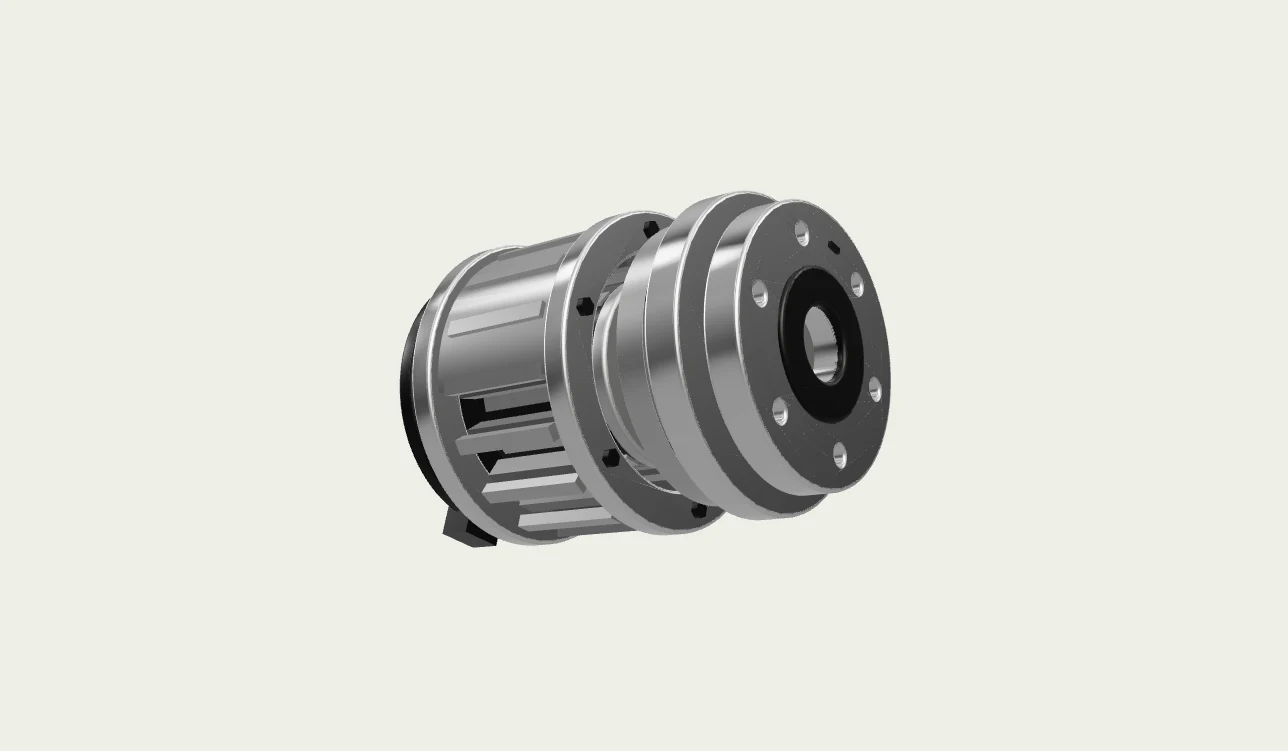
Actuation · Three-dimensional study
The stator surrounds the rotor. A shaft drives the sun gear; three planets turn inside a fixed ring. Their carrier becomes the output.
Actuation principle study: simplified gear surfaces and prescribed motion. This four-to-one example is not the selected hand drive or a tested actuator.
Select a stage to follow how electrical energy becomes contact, and how the hand learns what happened.
A functional diagram of the proposed hand architecture. Select a stage to inspect its role; this is not a wiring drawing or a force simulation.
A local driver regulates motor current. Electrical energy becomes shaft torque; losses become heat that the compact enclosure must remove.
Explanatory diagram · Select a connection to inspect its role.
The useful measure of a hand is how it meets the object. It must build force when contact is secure, yield when contact changes, and release with the same care it used to grasp.
That asks more of a mechanism than a powerful motor. The tendon path, transmission, sensors and control timing must agree about what the fingers are doing.
We are pursuing the smallest complete system that can make that agreement reliable.
Compact actuators belong within the forearm. Bearings, fasteners, heat paths and service access belong in the design from the beginning.
A changing pose changes cable length. Useful motion requires compatible routes, adequate travel and measured tension—not a cable drawn between two points.
Commands describe an intention. Sensors describe the result. A controllable hand needs both, with faults that stop the next action from compounding the first.
Changing a gear ratio changes speed, current, mass and heat. Changing a tendon guide changes travel, friction and control. Our engineering process keeps those relationships attached to the same design.
The arm programme remains in development. Full tendon routing, active electronics placement, sustained thermal performance and loaded grasp validation are open. The illustration above explains an actuation principle; native CAD, calculations and independent review determine the actual build.
How we test an idea