Human form.
Engineered from within.
Keep the proportions that make a hand familiar. Reconsider what lies beneath: the joints, the paths of force and the surfaces that meet the world.
From fingertip to wristInspect the development CAD ↗
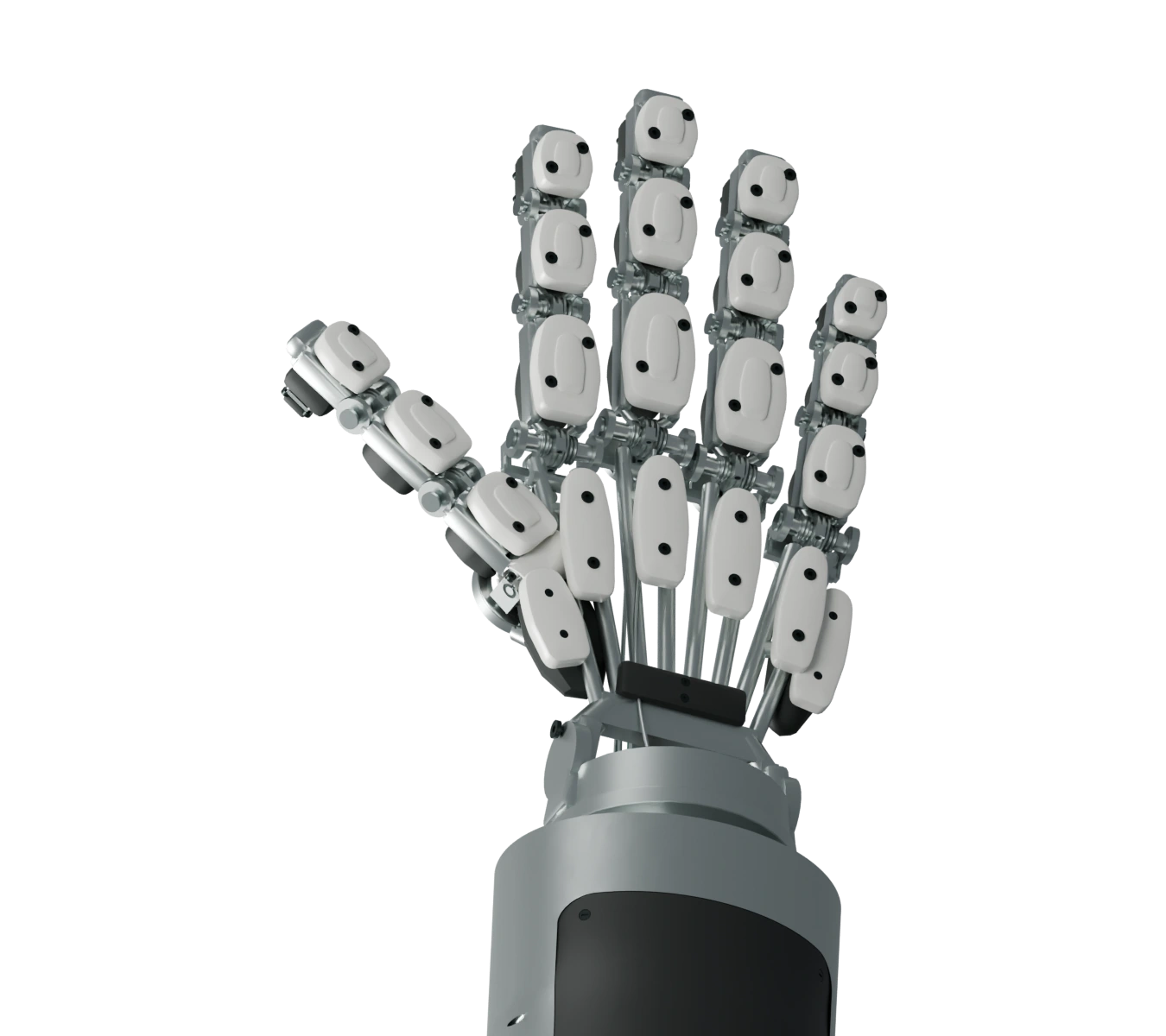
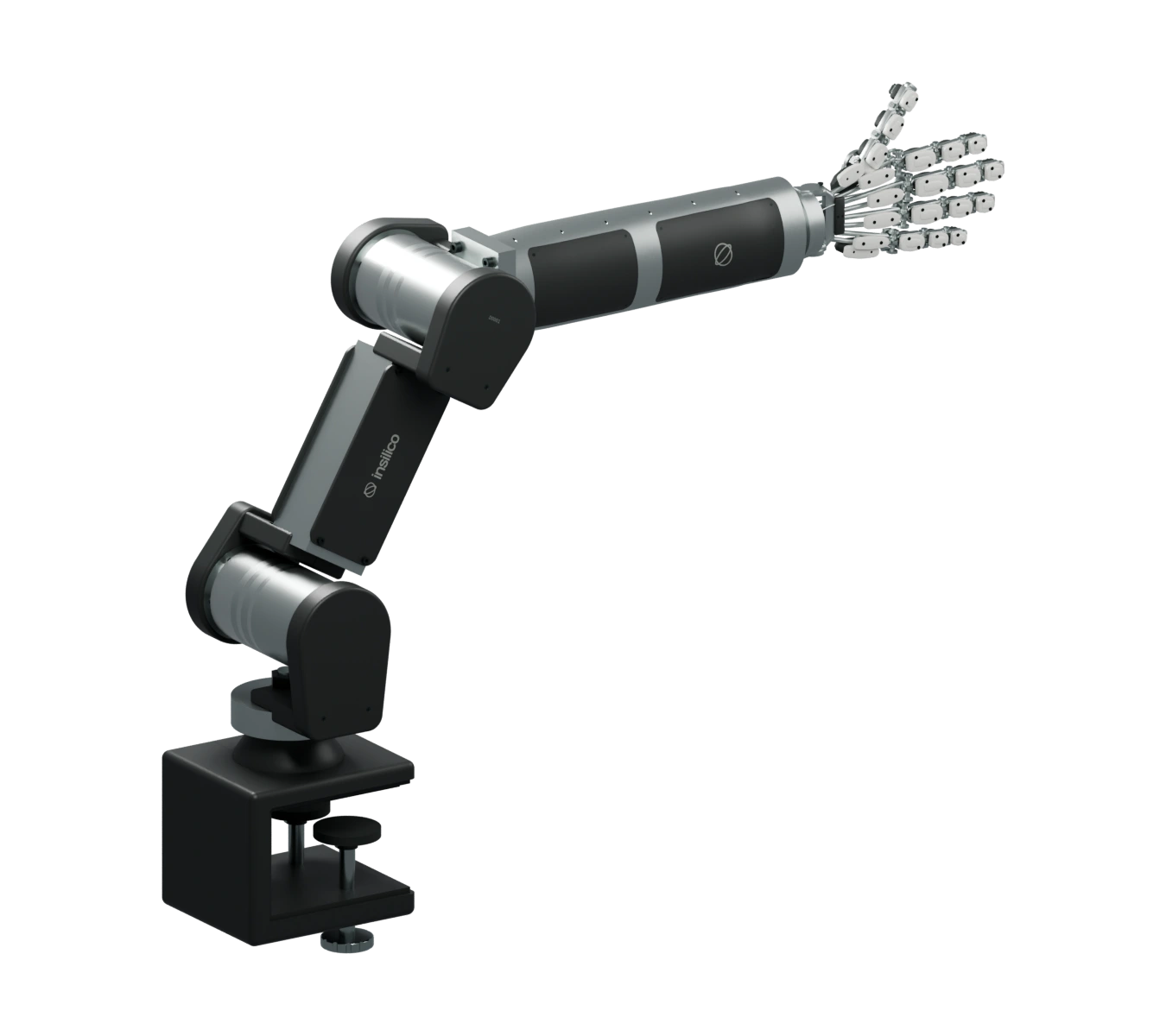
Hand to arm · Three-dimensional study
Camera controls
Begin where we touch the world.
Explore the articulated hand, then select Complete arm to follow its connection through the forearm, elbow and shoulder to the desk clamp.
Development study. Motion illustrates joint geometry; working tendon control and physical validation remain unfinished. Exploded view omits the two modeled wrist tendon strands; rigid guides and the passive electrical harness remain visible. Reassemble to inspect the actual modeled routes.
Inside Hand to arm
- Original hand
- The anatomy-inspired hand preserves its articulated fingers, opposing thumb and layered contact surfaces. Three fingertips illustrate bounded joint motion. The middle finger stays still while its new tendon path is studied.
- Wrist connection
- A retained flange joins the hand and forearm. The selected fixed-wrist pose still has gaps at two middle-finger tendon terminals. All forty-two end-to-end routes, retention and moving-joint compensation remain unverified.
- Forearm
- The enclosure surrounds twenty-one custom finger-drive cartridges. Complete tendon routing and working finger control remain unfinished.
- Elbow and shoulder
- Custom planetary transmissions sit inside the arm joints. Motor and gearbox layouts are development geometry, not a demonstrated powered robot.
- Desk clamp
- The sculpted enclosure surrounds the retained clamp mechanism. The jaws and adjustment handles remain accessible.
- Service access
- Exploded inspection separates rigid parts and fasteners. The two modeled wrist tendon strands are omitted because their saved shapes do not follow separated parts. Rigid guides and the intact passive electrical harness remain visible; some guide ends are intentionally unconnected. Reassemble to inspect the actual modeled routes. These offsets are not an assembly procedure.
The palm participates.
The thumb makes it a hand.
Dexterity comes from relationships. Finger lengths differ. The palm cups as the outer fingers close. The thumb turns across the hand to meet the other fingertips.
Those relationships guide the shape and motion of this design. Its animation illustrates selected joint movement; coordinated grasping remains a control and routing objective.
Open the layers to see how contact surfaces, joints, tendon paths and the wrist connect. The human silhouette remains the starting point.
A compact wrist.
A clear path into the arm.
The connection has three distinct jobs. A retained flange carries the hand’s loads. Paired tendons transmit force from the forearm drives to the finger joints. A separate electrical harness carries sensor power and data. The current development assembly uses a fixed wrist; an articulated wrist and complete finger control remain future revisions.
- Support
- The wrist flange and retained fasteners carry structural loads into the forearm.
- Actuation
- Motors and transmissions pull paired tendons. The current pose leaves gaps at both middle-finger tendon terminals. All forty-two end-to-end routes and moving-joint compensation remain unverified.
- Feedback
- The proposed electrical path brings joint, tension and tactile measurements back to the controller, separately from the force-carrying tendons.
- Vision
- A rigid forearm camera is the selected direction for a close view of the hand’s workspace. It follows the arm while keeping a fixed relationship to its mount.
Development architecture. Complete tendon routing, common-length compensation, loaded drive performance, electronics and physical validation remain unfinished. The rendered motion does not demonstrate working control.
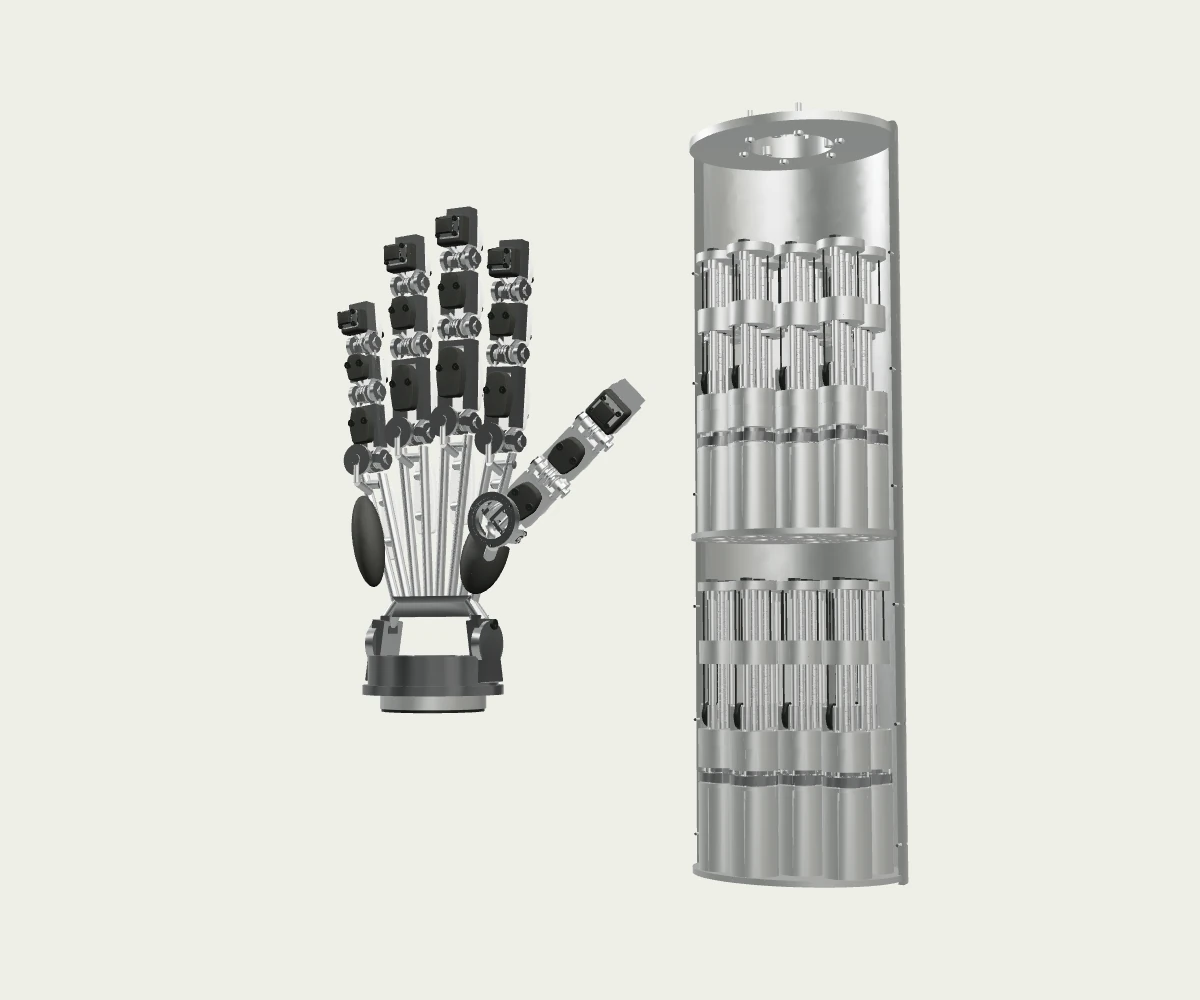
The hand / CAD inspection · Three-dimensional study
Hand + forearm · Separated · Open housing
Tendon paths are hidden while the parts are exploded. Choose Collapse parts to inspect the nominal hand routing.
Two modules. One shared interface.
Inspect the hand and forearm at the same scale. Assemble them at the wrist, or open the housings to explore the custom transmission cartridges, bearings and fasteners.
Development CAD with display meshes optimized for the browser. Neutral assembly and inspection offsets only. This candidate is not released for fabrication or powered operation.
Inside The hand / CAD inspection
- The hand
- Four finger chains and a three-axis thumb base. The engineering candidate currently uses a fixed palm and fixed wrist interface.
- The custom wrist
- A keyed pilot, retained socket and indexed tendon passages connect to our own forearm interface. No Tesla mechanical compatibility is claimed.
- The forearm
- Twenty-one custom transmission cartridges are packaged in a 76 × 64 mm forearm body, 260 mm long plus its wrist interface. Purchased bare motor envelopes sit inside custom drive assemblies.
- The next engineering test
- Resolve tendon common-mode travel, thumb clearance, tolerances and retained routing before powered assembly.
Precise in movement.
Considered in every layer.
The hand should be as thoughtful to maintain as it is to move.
- Move
Coordinate the whole gesture.
Develop the fingers, palm and opposing thumb as one articulated system. Preserve smooth transitions between the gestures a task needs.
- Feel
Separate support from investigation.
Explore a fingertip with a supporting perimeter and a small sensing island. Measure how sensing motion affects the grasp.
- Maintain
Make the wearing parts accessible.
Design skins, pads and tendon interfaces for replacement, then test whether calibration and performance can be recovered.
Three paths through the wrist.
Mechanical support, tendon force and electronic signals have separate jobs.
Retained flanges, fasteners and bearings carry structural loads.
Explanatory diagram · Select a connection to inspect its role.